
Divine Encounters with Jesus – “Jesus in the Graveyard”
This week, we tackle the strange story of the demon-possessed man who Jesus meets in the graveyard in Mark 5. It’s a story that forces us to wrestle with the reality of evil — what it is, where it comes from, and how it affects people – and, most importantly, how it is healed.
1. Lessons on Evil
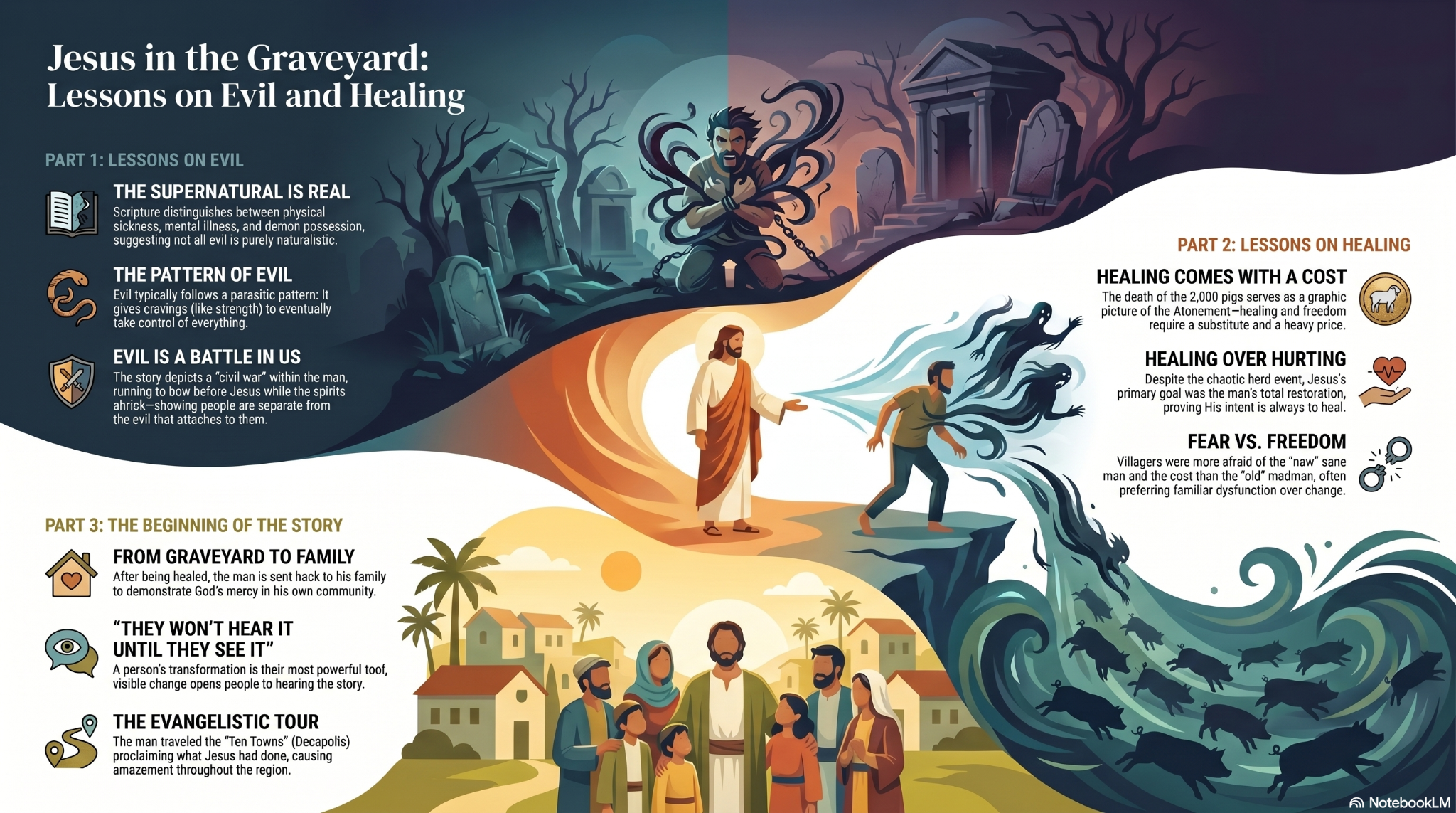
- The supernatural is real (Mark 5:1-2; Matthew 4:24) – Mark doesn’t soften the language — the man is “possessed by an evil spirit.” Scripture is neither reductionist nor sensationalist about demonic influence of people, and we shouldn’t be either. Reductionists attempt to reduce every unexplained phenomenon or behavior into a natural explanation, discounting the supernatural (with no real explanation for the reality of evil in the world). Sensationalists see supernatural forces (demonic influence) behind every disease, mental illness or evil action someone does.
- Evil will give you something so it can take over everything (Mark 5:3-4) – The man had super-human strength — exactly what the demons gave him in exchange for total control of his life. Whatever the soul craves — sexual pleasure, fame, wealth, power — evil hands it over as bait. You’ve probably watched this pattern unfold in someone you love – someone who lost everything.
- Evil is a battle in us (Mark 5:6-8) – Oddly, the man both bows before Jesus and shrieks in resistance — Mark clearly separates the man from the evil spirit(s). Inside all of us a battle rages – a battle against “the world, the flesh and the devil.” Evil is always trying to influence us, but we have to be careful about confusing the person and the influence – people are not “demonic.”
2. Lessons on Healing
- Healing comes with a cost (Mark 5:9-13) – The 2,000 pigs plunging into the lake aren’t a quirky detail or a “mean move” by Jesus — they’re a foreshadowing of the cross, a reminder that our healing from sin and death (i.e., atonement) came with a cost. To take the evil and sin from the man in the caves, animals had to die – just like Jesus had to suffer and die to take away our sin.
- Jesus wants to heal us, not hurt us (Mark 5:14-17) – The townspeople’s reaction to the healing is startling: it appears that they’re more afraid of Jesus than they had been of the madman, and they beg him to leave. There comes a point in our battle with evil when we encounter the cost of healing – what we’re going to have to do or give up to be healed. At that point, we have to decide whether it’s worth it – and whether we can trust that Jesus wants to heal us, not hurt us.
- Healing is the beginning of the story, not the end (Mark 5:18-20) – The man, once healed, wanted to go with Jesus to serve him, but Jesus told him to “go home to your family.” He wanted the man to enjoy his restored life and to show and tell those who knew him what Jesus had done from him. So he did – first in his own town and family, then in all the surrounding towns as well.
- Our healing from sin and evil is just the beginning of our “Jesus story” as well. Once we’re freed from the evil and sin that controlled and enslaved us, we have a new purpose for our lives: to show and tell others about what Jesus has done for us – and what he can do for them, too.
ADDITIONAL SCRIPTURE
These passages may provide additional insights related to the subject of this week’s message. All verses are NLT unless otherwise noted.
Psalms 23:4; Ephesians 6:10-13; Colossians 2:13-15; James 4:7; 1 Peter 5:8-9; 1 John 4:4
Video of the Week: The Satan and Demons by Bible Project
QUESTIONS FOR REFLECTION AND DISCUSSION
- When you hear the word “evil,” what comes to mind first — something distant and abstract, or something close and personal? Explain your answer.
- The message warned against two extremes: reductionism (everything that happens has a natural explanation) and sensationalism (everything negative that happens is demonic). If you’re honest, which of those extremes do you tend to drift toward – and how does that effect your worldview?
- Read Mark 5:1-13 again. What stands out about how Mark introduces this man? Why do you think Jesus crossed the lake into “unclean territory” just to meet him?
- The message described evil as a parasite that “gives you something so it can take everything.” Where do you see this pattern at work in our culture, in people’s stories you know, or in your own past?
- The odd detail of 2,000 drowned pigs can be seen as a picture of atonement — the reality that healing from sin and evil always comes with a cost, a cost that Jesus ultimately paid once and for all on the cross. By your understanding, why is that true? In other words, why did Jesus have to die to free us from sin and death?
- Is there a “21-year-old Toyota” in your life — something familiar that’s costing you more than you want to admit, but you’re afraid to let go of it? What would it look like to trust Jesus with that thing – that harmful habit or secret sin – this week?
Looking for a group to explore with?
Find your people.
